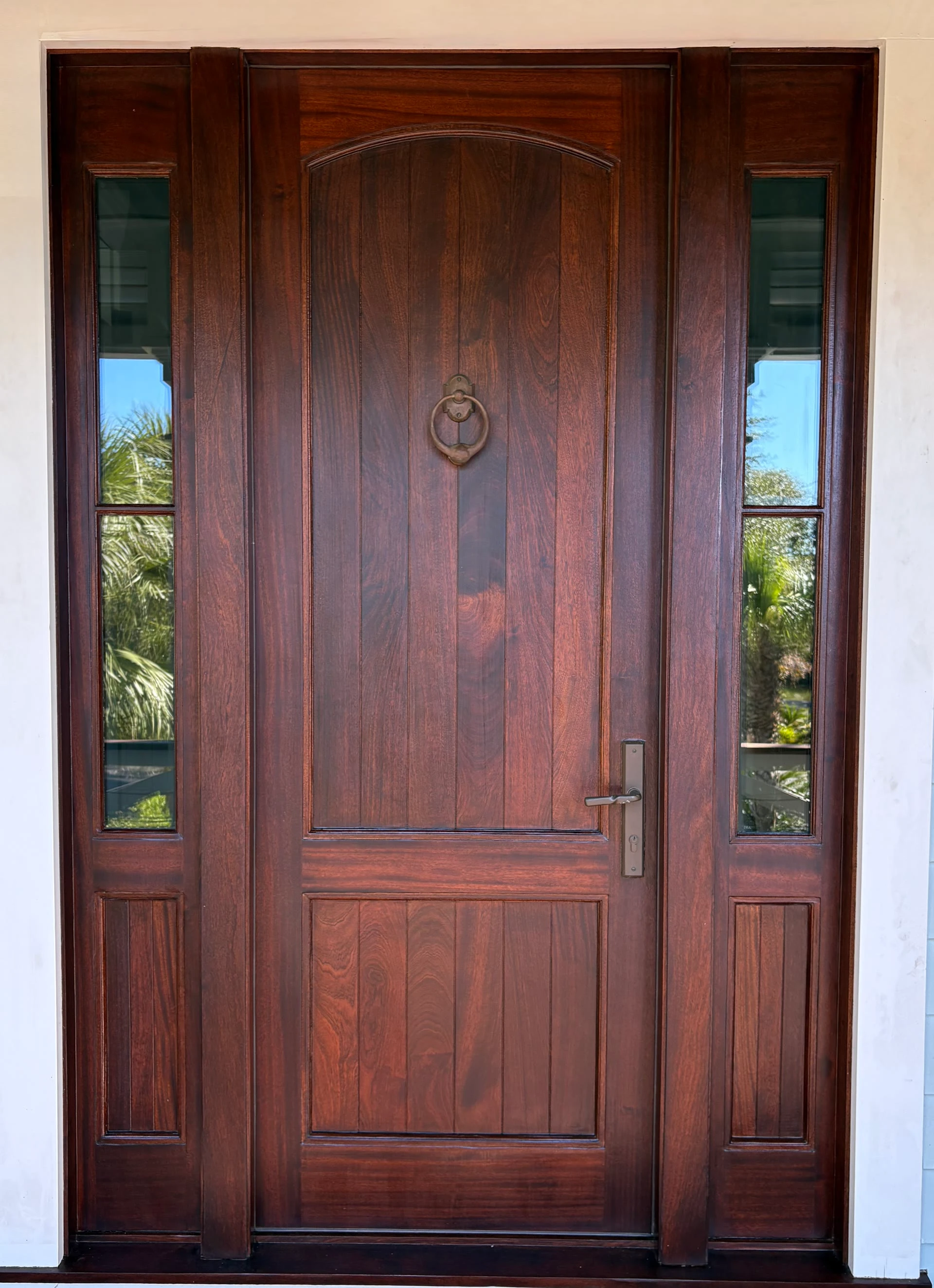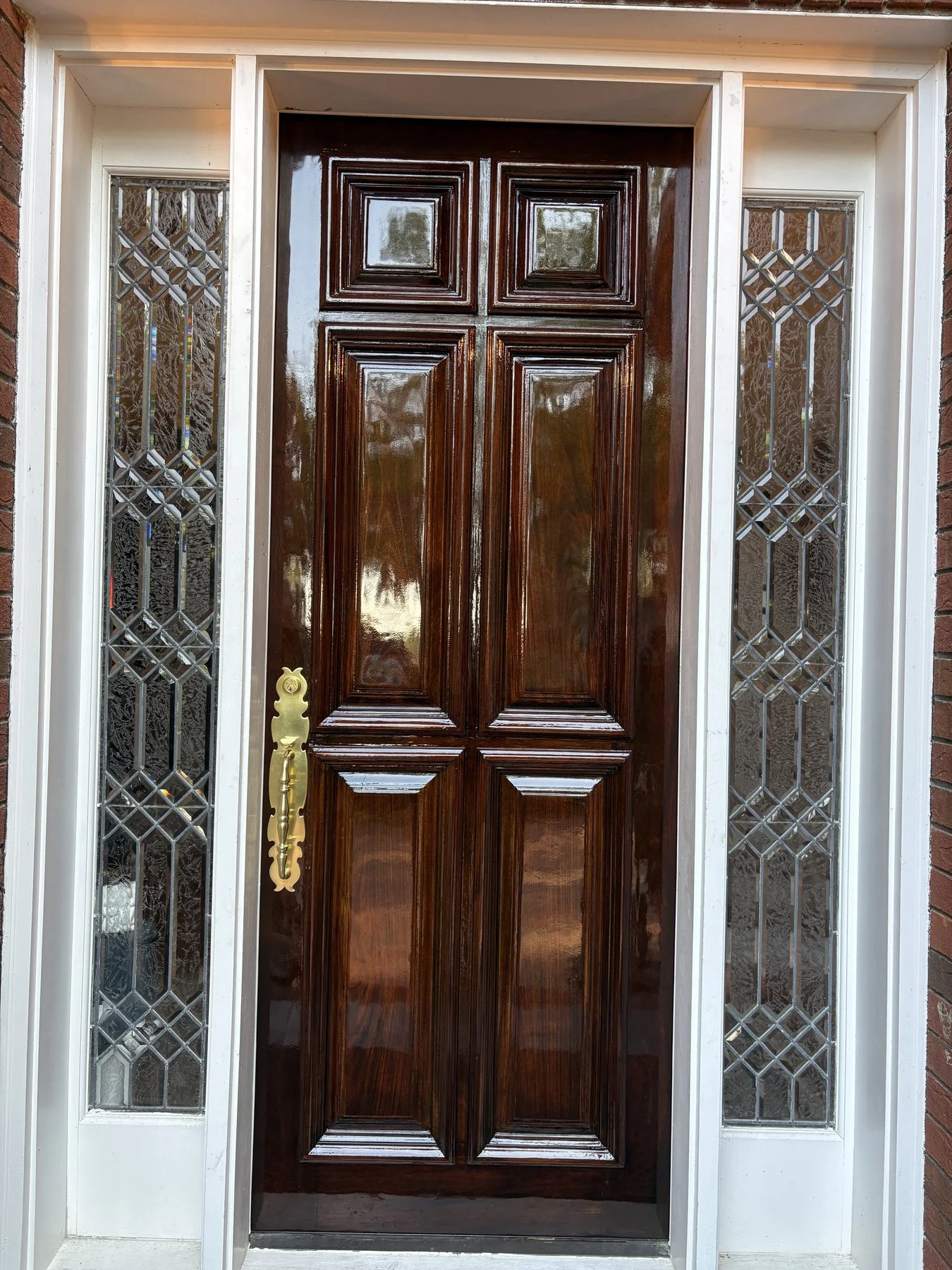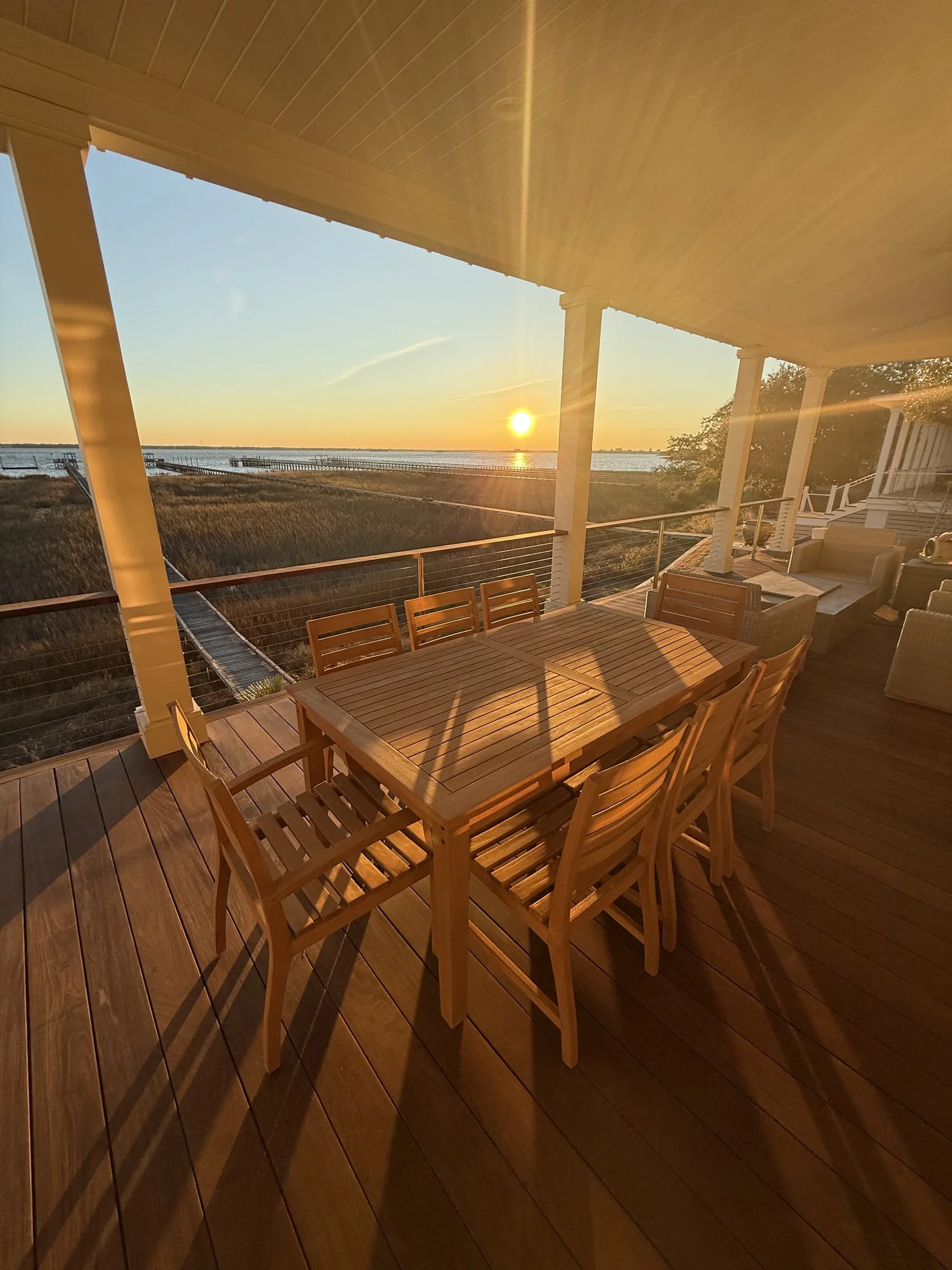

You spent good money on a solid wood front door. Two summers later the finish is cloudy near the bottom, there's a chalky haze where the afternoon sun hits, and the grain feels dry to the touch. The door itself is fine. The finish on top of it gave out.
This is the most common door problem we see in Charleston, and it's almost never the wood. It's the coating, and the climate it was asked to survive.
What Charleston actually does to a front door
A south or west-facing entry door in the Lowcountry takes a beating most finishes aren't built for. UV breaks down the resin in the coating from above. Salt air settles into every surface and accelerates the breakdown. Humidity drives moisture into the wood, then the sun bakes it back out, over and over. That expansion and contraction cycle is what cracks a finish and lets water get underneath it.
The door that fails fastest is almost always the one with the most direct sun. A shaded north-facing door can hold a finish for years. The same door facing west over a light-colored driveway can look tired in a single season.
Why the hardware-store finish doesn't hold up
Most failed doors we strip were coated with a general-purpose polyurethane or an exterior stain from a big-box store. These products look great going on. The problem shows up later.
Standard polyurethane is hard but rigid. When the wood moves with Charleston humidity, a rigid film can't flex with it, so it cracks and peels. Ordinary varnish has little real UV protection, so the coastal sun chalks it out. Neither was engineered for salt air and the moisture swings of a tidal climate.
The finish can look perfect for the first six months. What tells you whether it was the right product is how it looks eighteen months later.
What marine-grade varnish does differently
Marine varnish exists because boats face a harsher version of the same problem: constant sun, salt, and water on wood that moves. The formulas built for that environment carry two things ordinary coatings lack.
- Real UV inhibitors. Marine-grade varnish is loaded with UV absorbers that take the hit so the wood and the color underneath don't. This is the difference between a finish that holds its richness and one that chalks gray.
- Flexibility. A marine finish is built to flex as the wood expands and contracts. Instead of cracking with seasonal movement, it moves with the door.
The tradeoff is that these products cost more and take longer to apply correctly. The payoff is a finish that survives the conditions that destroy a box-store coating.
Why the number of coats matters
A single coat of even the best varnish isn't enough on a coastal door. Each coat adds depth, UV resistance, and a moisture barrier, and the early coats soak into the wood rather than building a protective film on top.
Our Elite Refinish Package builds up five coats of marine-grade UV varnish, then adds two to three coats of a matte topcoat for the final look and an extra layer of protection. That depth is what lets the finish take years of Charleston sun before it needs attention again. Garage doors and interior doors are handled through the same tiered approach, matched to how much weather each one actually sees.
The prep is half the job
A great finish over bad prep still fails. Most of the value in a professional door refinish is in the work that happens before any varnish goes on.
- Assessment of the door and a recommendation on the right package for its exposure
- Careful removal or on-site protection of the surrounding trim
- Complete stripping of the old, failed finish down to clean wood
- Precision sanding and surface correction so the new finish lays down evenly
- Multi-coat marine-grade varnish application
- Hardware reinstallation and a final inspection
Skip the stripping and sanding and you're just painting over the problem. It will come back, usually within a year.
Refinish or replace?
In almost every case, refinishing wins. A solid wood door is worth restoring, and the cost reflects that. Professional door refinishing is priced on hours, and a full marine-grade build on an exterior door is a multi-day process, so most single front door projects in the Charleston area land in the several-thousand-dollar range depending on the door, its condition, and the package. Replacing a quality wood entry door with installation typically runs $2,000 to $8,000 and throws away a door that was usually fine underneath the failed finish.
Replacement only makes sense when the wood itself is compromised: rot through the bottom rail, delamination, or structural cracking. We check for that first and tell you honestly which way to go.
Frequently asked questions
How often does a front door need refinishing in Charleston?
There's no single schedule. A shaded, protected door can go several years. A west or south-facing door in direct sun and salt air may need attention in two to three. The right approach is to inspect it and catch the early signs before water gets into the wood. Hazy or chalky finish, dryness to the touch, and any cracking or peeling all mean it's time.
What is marine-grade varnish, and why is it better for a coastal door?
Marine-grade varnish is a finish engineered for boats, with heavy UV inhibitors and built-in flexibility so it survives constant sun, salt, and moisture on wood that moves. On a Charleston front door it holds color and resists cracking far longer than the general-purpose polyurethane or exterior stain sold at hardware stores.
Can you refinish a door without taking it off its hinges?
In many cases, yes. The right method depends on the door and the package. Some doors are best finished in place with the surrounding trim protected; others come down for full stripping and a more controlled finish. We make that call during the assessment.
Do you refinish garage doors and interior doors too?
Yes. Exterior, garage, and interior doors are all handled through our tiered refinishing packages, with the level of protection matched to how much sun and weather each door actually faces.
My door is faded and dry. Is it too late?
Usually not. Faded color and a dried-out surface mean the finish has worn through, but the wood underneath is typically sound. That's exactly what a full strip-and-refinish corrects. We confirm the wood is solid during the assessment before recommending the work.