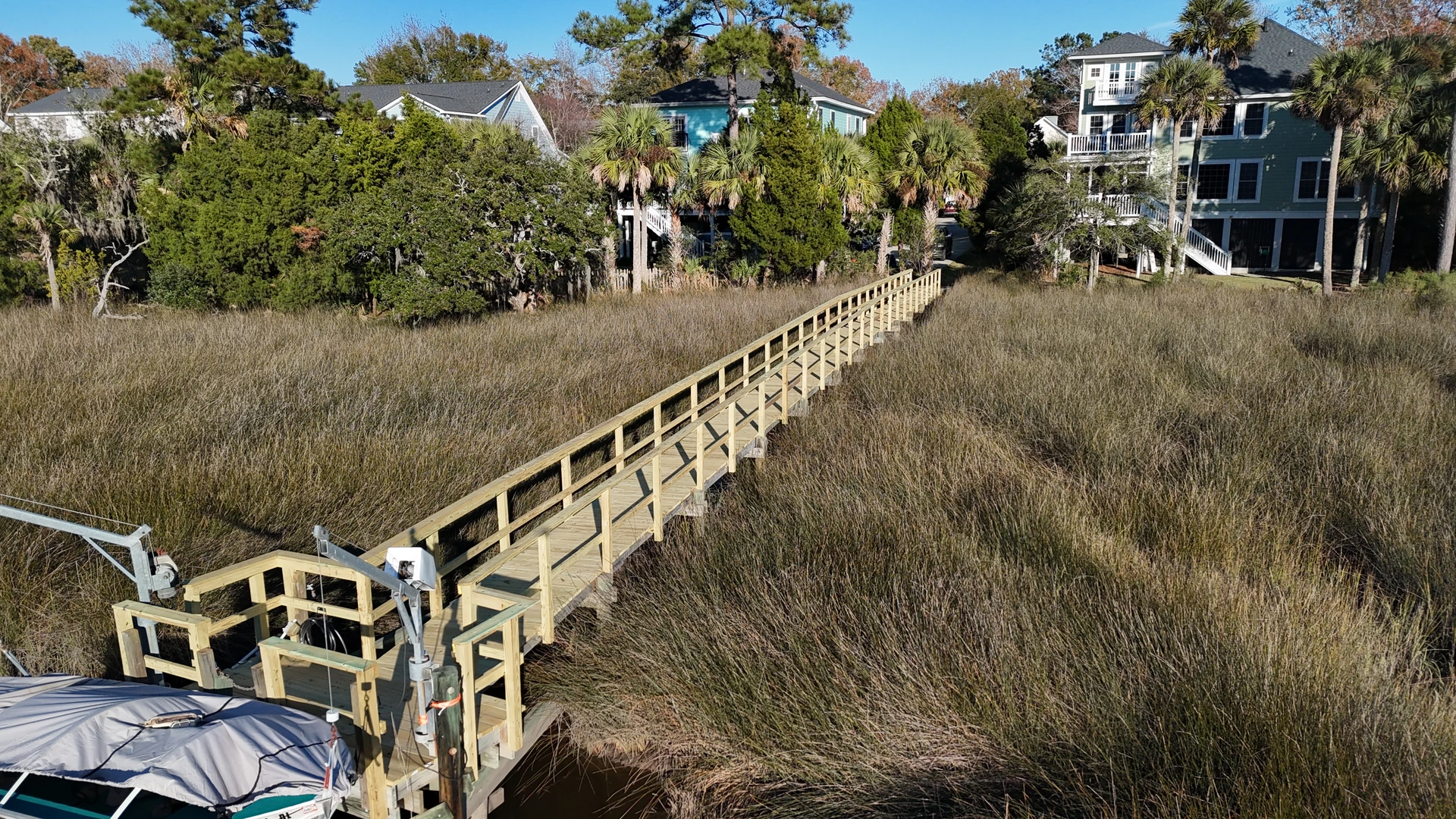
A dock is the hardest-working wood on a Lowcountry property. Your deck deals with sun and humidity. Your dock deals with all of that plus brackish tidal water twice a day, salt spray off the marsh, and the kind of constant wet-dry cycling that finds every weak spot in a finish. If you've got a dock on a tidal creek in Charleston, it's aging faster than anything else you own outdoors.
Here's what dock restoration actually involves in this climate, and how to tell when yours has gone past routine upkeep.
Why marsh-front docks fail faster than decks
A deck dries out between rains. A dock over a tidal creek often doesn't. The pilings and lower framing sit in the splash zone, soaking up brackish water on the rising tide and baking in the sun when it drops. That repeated swelling and shrinking is what loosens fasteners, opens cracks, and lifts a finish off the boards.
Salt makes it worse. Salt crystals work into the grain and into every metal connection. They hold moisture against the wood and accelerate corrosion on hardware that a non-coastal dock would never see. The result is that a dock which would last decades on a freshwater lake up north shows real wear here in a handful of seasons.
The three layers of a dock, and what each one needs
We look at a dock in three parts, because each one ages differently.
The decking surface — the boards you walk on. This is where sun and foot traffic show up first: graying, splintering, and a finish that's stopped beading water. This is the most common reason people call us about a dock.
The framing and railings — the structure above the waterline. Railings take direct sun and handle, so they fade and roughen. Joists and beams are usually sound longer, but they're worth inspecting because a problem here is a safety issue, not a cosmetic one.
The pilings and lower structure — the parts in or near the water. These see the harshest conditions and the least attention because they're hardest to look at. Soft spots, marine growth, and loosened connections start down here.
What professional dock restoration includes
- Full structural inspection — checking decking, framing, railings, and accessible pilings for soft spots, rot, and failed connections
- Cleaning and prep — removing marine growth, mildew, salt buildup, and the old failed finish
- Board and hardware repair — replacing damaged boards and corroded fasteners before any finish goes down
- Species-correct finishing — a penetrating, UV-resistant product matched to the wood and the brutal exposure a dock sees
- A maintenance interval — an honest read on how often this specific dock will need attention given its sun and water exposure
Signs your dock needs attention now
Do the water test on the decking: sprinkle a little water on the boards. If it beads, the finish is still working. If it soaks straight in, the protection is gone and the wood is taking on moisture every tide cycle.
Beyond that, watch for graying or blotchy color, splintering underfoot, any board that feels soft or spongy, loose or rusting hardware, and railings that flex more than they should. A soft spot anywhere structural is a reason to call sooner rather than later — on a dock, a failed board over the water is a safety problem, not just a looks problem.
Why the right product matters more on a dock than anywhere else
A film-forming finish that traps moisture is a bad idea on any coastal wood. On a dock that's wet twice a day, it's a guarantee of peeling. Dock wood needs a penetrating finish that lets the wood breathe while still blocking UV and repelling water. It's the same principle we apply to IPE decks, pushed harder because the exposure is harder.
As Marine Engineers by background, this is the environment we came from — protecting wood and metal against constant salt and water is the entire job on a vessel. A tidal dock is a version of the same problem, and it responds to the same disciplined approach.
Getting a quote
Free estimate on every dock. We walk the full structure, check for soft spots and failing connections, look at the existing finish, and give you a written breakdown before anything starts. If a section needs structural repair before it's safe to refinish, we'll tell you that upfront.
Frequently asked questions
How often does a dock need to be restored in the Charleston Lowcountry?
More often than a deck, because of tidal water and salt exposure. Most marsh-front docks in coastal SC need professional attention every 1 to 3 years for the walking surface, sooner for sun-baked, waterfront sections. Annual cleaning and a water test each season tells you where yours stands.
Can a dock be restored or does it have to be replaced?
In most cases it can be restored. Graying, splintering, and a worn finish are surface problems that a strip-clean-and-refinish corrects. Replacement is only necessary when the structure itself is compromised — rotted pilings, cracked framing, or failed connections. We inspect all of that first and give you an honest call before any work starts.
Do you restore the pilings and lower structure too, or just the deck boards?
We assess the whole dock — decking, railings, framing, and accessible pilings. The walking surface is the most common job, but the structure below the waterline is where safety problems begin, so it's always part of the inspection.
What finish do you use on a dock?
A penetrating, UV-resistant finish matched to the wood species — never a film-forming coating that would peel under constant tidal wetting. On dense hardwoods like IPE we use a professional-grade penetrating hardwood oil; on softwoods, a product engineered for high-moisture coastal exposure.